
What Incoterms Actually Mean in a Candy Purchase
A quotation that shows only a unit price per carton does not tell you what you will finally pay. Two suppliers can quote the same product and produce different landed costs, because the Incoterm decides who pays for which leg, who carries risk at each point, and who answers when a container waits at the terminal.
Incoterms are standard trade terms published by the International Chamber of Commerce, dividing cost, task and risk between seller and buyer. They are not a price list, and they do not set freight rates, which depend on route, season, carrier and volume. For a candy buyer they answer three questions: who arranges transport, who pays for what, and where risk passes to you.
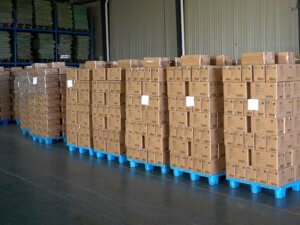
Why the Term You Agree On Changes Your Landed Cost
1. EXW (Ex Works)
The supplier packs the goods at the factory; inland haulage, export clearance, freight, insurance and delivery are yours. This suits buyers who consolidate several suppliers through one forwarder.
2.FOB (Free On Board)
The supplier delivers to the named port and clears the goods for export; risk passes when they are on board, and you control the main freight and insurance. Most container candy orders ship this way.
3.CIF and CFR
The supplier pays ocean freight, and under CIF also insurance, to the destination port. Risk still passes at the loading port, so a mid-voyage damage claim belongs to whoever holds the insurance interest.
4.DAP and DDP
Under DAP the supplier delivers to a named destination and you clear and pay duty on import. Under DDP everything is handled to the final destination — convenient for samples, but often impractical for commercial food imports, because many markets require the importer of record to be the locally registered food business.
What this means for you: write the Incoterm, and the named port or place, onto the purchase order itself, not only into the quotation email. A term without a location is not a term.
Which Terms Buyers Use Most, and Why
FOB and CIF dominate candy container shipping. FOB suits buyers with a forwarder who want control of cost and routing; CIF suits buyers who are new to importing and want one number to plan around. EXW appears mainly with experienced consolidators, and DDP stays in the sample lane.
Two rules follow. Compare quotations only at the same Incoterm, because an EXW quote always looks lower than a CIF quote for identical goods. Then ask for both an FOB and a CIF figure on the same product, so you can judge your own forwarder against it. One further point matters for confectionery: whoever arranges the freight also chooses the equipment.

What Documents Should Travel With a Candy Shipment?
Documents are where a candy import either clears smoothly or waits at the port. Missing, late or inconsistent paperwork is the most avoidable cost in food importing, because clearance stops while storage and demurrage keep running.
1.Commercial and Transport Documents
Commercial invoice — goods, quantity, unit value, total value, Incoterm and currency; the description must match the packing list and the customs declaration.
Packing list — carton count, contents per carton, net and gross weight, dimensions and pallet configuration. Your warehouse and customs work from this document.
Bill of lading — issued by the carrier or forwarder; confirm whether you receive original bills or a sea waybill, and make sure the consignee matches your importer of record.
Certificate of origin — issued through the competent chamber or trade body, establishing origin and supporting preferential tariff treatment.
Insurance certificate — required under CIF, and advisable on any heat-sensitive shipment.
2.Product and Compliance Documents
Health or sanitary certificate — issued by the Chinese entry-exit inspection and quarantine authority. Some markets require specific wording, so confirm before production.
Ingredient and allergen declaration — the full ingredient list and allergen statements, aligned with destination labeling rules; for the United States, FDA food labeling requirements set the reference standard.
Certificate of analysis (COA) — a batch-level document reporting the parameters agreed in the specification, used for your release decision and by retail customers.
Halal certificate — required by certain Middle East and Southeast Asian markets; confirms the absence of prohibited ingredients and separation in production.
Label compliance file — approved artwork showing nutrition information, allergens, net weight, importer details, origin and required languages.
Name the importer of record and the required label language before artwork is finalized, and request draft documents before the vessel sails, because corrections after departure are slow. A supplier working under ISO 22000 or a BRCGS audited food safety system is better placed to produce a consistent document set, and products aimed at global markets should be checked against the Codex Alimentarius reference standards.

Booking Space or Scheduling Production: Which Comes First?
Neither happens strictly first, and treating them as a sequence is what causes missed vessels. Production scheduling and space booking run in parallel, aligned by one shared date: the cargo ready date.
The order and deposit confirm the specification. The supplier then reserves a production slot and gives you a cargo ready date range rather than a single day. With that range, whoever owns the freight under your Incoterm books space provisionally — space tightens before major holidays and around Chinese New Year, when carriers reallocate capacity and the factory workforce travels home.
What this means for you: put the cargo ready date in writing as a range and hold the booking trigger to it. Late artwork approval and late balance payment delay shipments as often as capacity does.
How Container Choice and Loading Method Affect Cost and Damage
Two decisions taken at loading shape both freight economics and damage rates: the equipment and the loading method.
On equipment, the question is whether the product needs temperature-controlled equipment or a standard dry container. Hard candy is the most tolerant, while chocolate, coated products, marshmallow and some gummy formats are more sensitive to heat and humidity, and a product that travels safely in one container type in one season may not in another.
On loading, the trade-off is volume against handling risk. Palletized loads use more container cube than floor-loaded cartons but reduce manual handling, which matters for fragile shapes: lollipops on sticks, moulded novelty items and candy toys are more damage-prone than a sealed bag of hard candy.
Mixing categories in one container spreads freight cost across several SKUs, but sensitive products then inherit the conditions of the least demanding items in the same unit. For fragile novelty formats such as the candy toy range, carton and inner packing design decide the damage rate as much as the shipping method does.
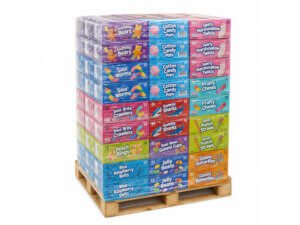
Inspection and Release: The Points That Decide Whether Goods Ship
Inspection belongs at three points. During production, factory quality checks appearance, weight and sealing on the line. After packing, a pre-shipment inspection confirms finished goods against the approved sample and specification: colour and shape, net weight, seal integrity, date coding, carton marking and label versus approved artwork. At loading, container supervision records the seal number and the carton count.
Who inspects is a commercial choice. Factory QC is always present; for a first order, a new formula or a high-value private-label run, a third-party inspection arranged by you is a reasonable cost. What matters is that inspection is a gate with a pass or fail outcome before the container is sealed; a defect found after sealing is a claim rather than a correction.
Payment structure should mirror those gates: tying the balance to a copy of the bill of lading plus the inspection report gives you leverage that a “goods are ready” message does not. For the wider order mechanics, the nine-step wholesale process that MPS Candy publishes is a useful reference to check a supplier’s answers against.
What this means for you: define inspection points, acceptance criteria and the payment trigger in the contract, because ambiguity here turns a small packing defect into a negotiation at your warehouse.
Where Do Delays Usually Come From?
Most candy shipments are not delayed by the ocean. They are delayed before the container reaches the port.
- Artwork and label approval cycles, where every round of comments costs calendar time.
- Packaging material lead time: printed film, display boxes, jars and tins are produced separately from the candy.
- Specification changes after approval, which reset the sample and the paperwork.
- Peak-season capacity limits on both sides, particularly around Chinese New Year.
- Port congestion and blank sailings, which move a cargo ready date that was previously workable.
- Documents that disagree with each other across invoice, packing list and declaration.
- Destination inspection by customs or the food authority, which you cannot compress.
- Buyer-side delay: late deposit, late artwork approval, late balance payment.
What this means for you: build a buffer between the cargo ready date and the vessel you intend to load, freeze the specification before the deposit, and give the document set one named owner on your side.

What This Means for Your Next Order
The sequence that keeps cost and risk predictable is: choose the Incoterm that matches who can execute each leg best, fix the document set on the purchase order, align the space booking to a written cargo ready date, choose equipment and loading based on product fragility, and define inspection and release gates before production begins.
For a first or second order, the lowest-risk version of that plan is to start with proven products rather than a fully custom development, apply private label to the pack, test the market, and expand the SKU range once sales are verified. That keeps the technical variables small while you learn how the supplier works.
If you are planning a development rather than a repeat order, the same logic applies with one addition: involve the factory earlier. Our OEM/ODM marshmallow programme shows how sampling, specification and packing decisions interlock before a production slot is committed.
Frequently Asked Questions About Wholesale Candy Sourcing from China
1. Which Incoterm should I choose for a candy order from China?
FOB is the most common choice for container orders, because the supplier handles export clearance and you control the main freight, insurance and routing. Choose CIF if you prefer a single delivered-to-port number and do not yet have a forwarder. Use EXW only if you already consolidate several suppliers through one forwarder. DDP is normally reserved for samples and small trials, since many markets require the importer of record to be the locally registered food business.
2. What documents do I need to import candy from China?
At minimum: commercial invoice, packing list, bill of lading, certificate of origin, health or sanitary certificate, ingredient and allergen declaration, certificate of analysis, and a label compliance file approved for your market. Halal certification is added when the destination market requires it. Your customs broker can confirm which of these your market treats as mandatory, and your supplier should provide drafts before the vessel sails.
3. Should I book shipping space before production is finished?
Yes, provisionally. Firm space cannot be booked without a realistic cargo ready date, and a realistic date cannot be promised without a production schedule, so the two are aligned early and then confirmed. Waiting until the goods are packed to start booking removes your options precisely in the periods when space is tightest, such as the weeks around Chinese New Year.
4. What is the typical MOQ for wholesale candy from China?
For many candy products, the typical MOQ is approximately 2–4 metric tons per flavor, depending on formula, shape, production process and packaging requirements. A custom mould, a bespoke flavour or a fully printed pack will normally sit above that range, because tooling and material runs have to be amortized across the order. Exact figures are confirmed per product and project.
5. How do I inspect candy before it ships?
Define three gates: inline checks during production, a pre-shipment inspection after packing against the approved sample and specification, and container loading supervision that records the seal number and loaded carton count. For a first order, a new formula or a private-label run, commissioning a third-party inspection is a reasonable cost, and tying the balance payment to the inspection report plus a copy of the bill of lading gives that gate real weight.
6. What causes delays in candy shipments from China?
The most frequent causes are slow artwork and label approval, packaging material lead time, specification changes after approval, peak-season capacity limits on both the carrier and factory side, port congestion, incomplete documents, destination inspection, and buyer-side delays such as a late deposit or late balance. Only the last group is fully within your control, which is why freezing the specification before the deposit matters so much.

Send Your Product Brief and Get a Confirmed Plan
Send your product brief — candy type and format, target volume, packaging format, destination market and required documents — and MPS Candy will confirm the matching production line, the MOQ, the Incoterm and port that fit your route, and the documentation set your market requires. Our export team works with a multi-factory supply chain and 30+ production lines, plus R&D support for custom formulas and packaging, so the answer reflects what can actually be built. You can review our manufacturing and export background before you write, and if your project is not a fit for our lines, we will tell you.
